By Jacopo DeMarinis, Master’s in Peace and Conflict Studies
July 12th doesn’t really impact my life, but still I leave the city on the 12th.
This is what one of the participants in my recent community vision board workshop said when asked about how community relations impacts his life. Yet another participant, a man from England, remarked that, “Everyday life is impacted simply in the perceived ability to travel amongst Belfast.” These contradictory comments about community relations highlight the complexity and subjective nature of reconciliation and community in the region.
What should community relations efforts seek to achieve?
The answer may depend on what our vision of a reconciled, united society looks like.
This was the focus of my workshop. Eleven people of diverse backgrounds participated, and I combed their vision boards for images and statements reflecting either a vision of thin reconciliation – merely peaceful coexistence – or thick reconciliation, characterised by positive, trusting intergroup relationships and a commitment to justice and a shared understanding of the past.
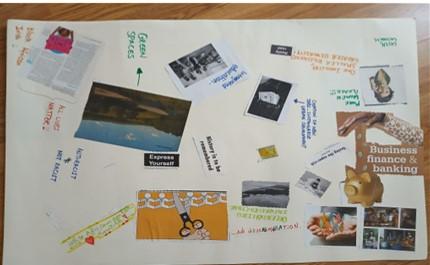
The vision boards were unanimous in their vision: one of thick reconciliation. They stressed social integration, addressed economic considerations like unemployment and funding for community organisations, and challenged sectarian narratives and the mistrust inherent in them.
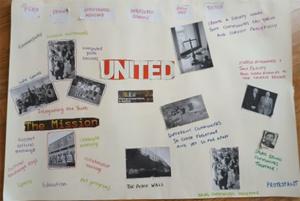
Exploring what aspects of peacebuilding were prioritised was particularly revealing. For example, the vision board below emphasises relational healing, with a strong focus on integration. The board is peppered with symbols of integration such as integrated classrooms and sports teams. Yet perhaps the most powerful image is the iconic photo of Martin McGuinness and Ian Paisley, with the caption, From Sworn Enemies to Chuckle Brothers. This image illustrates a hopeful vision of a united Belfast transformed through integration and bridgebuilding: after all, if Paisley and McGuinness could bury the hatchet, anyone can.
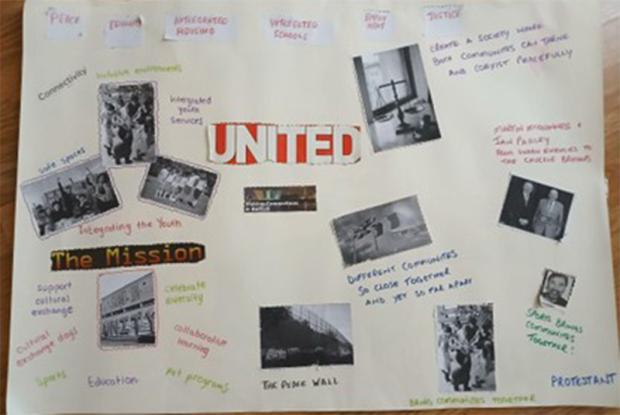
Vision Board 2: Created by two Protestant women
Conversely, this vision board focuses more on the cultural aspects of peacebuilding, including pushing the envelope of entrenched social norms. Phrases like “redefine the populist era”, “we run this city together!”, “stop racism!”, and “global imagination” challenge cultural conventions and the idea of what is possible, while promoting bridgebuilding and a culture of shared responsibility.
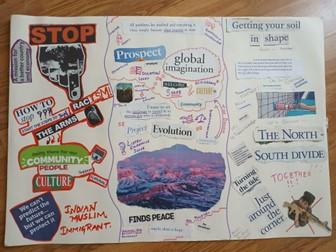
Vision Board 1: Created by a woman of mixed Irish/British background, a Muslim woman of Indian descent, and a man from England
Despite these powerful, hopeful vision boards, only one participant mentioned legacy issues – they were not eager to talk about dealing with the past. While this is understandable, the past shapes the future, and our collective visions should be informed by at least some shared understanding of and personal peace with the past.
The reaction to the new Legacy Act agreement highlights the need to create safe spaces for people to heal on a personal level, explore each other’s narratives, and challenge their own perspectives on the conflict – “getting (their) soil in shape,” as Vision Board 1 puts it – before building a shared vision of a better future. Perhaps establishing community centres in every community – spaces for storytelling, trauma healing, and vision board workshops – could be a first step in this long but ever so worthy process of reconciliation that many in Northern Ireland are eager to embark on.
Jacopo DeMarinis has a Master’s in Peace and Conflict Studies from Ulster University. He is pursuing a career in peace education, and can be reached at jjdemarinis@gmail.com.
Vision Boards Reflecting Workshop Participants’ “Visions of a better, united Belfast”
Vision Board 1: Created by a woman of mixed Irish/British background, a Muslim woman of Indian descent, and a man from England
Vision Board 2: Created by two Protestant women
Vision Board 3: Created by an African woman from Kenya, an Irish Catholic man, and an African woman of Berber descent
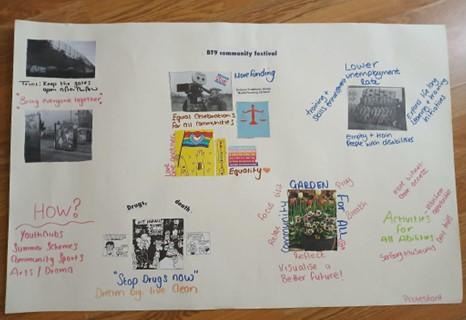
Vision Board 4: Created by two Protestant women