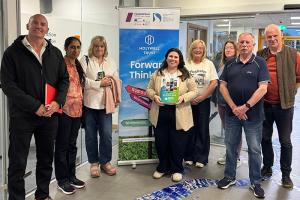
Written by Sara Duddy, programme manager at Holywell Trust. The Community Relations Council supports the organisation though its Core Funding Scheme.
In June 2026 Holywell Trust in Derry-Londonderry held two workshops as part of their Forward Thinking project examining the constitutional future question through a series of workshops and study visits. Forward Thinking is funded through SEUPB and Derry City and Strabane District Council’s Local PeacePlus Action Plan.
Emma Rooney, Senior Policy Officer from European Movement Ireland (EMI) delivered a workshop on 03 June, and Dr David Phinnemore from Queen’s University Belfast, on 24 June.
EMI’s research, carried out by Amárach Research, examined “attitudes to the EU across the island of Ireland” through a nationally representative sample in both jurisdictions in March 2026. In-person focus groups were then carried out to explore issues in greater depth.
When published, EMI anticipated the findings around the EU’s relationship with the US, migration, or defence spending by the EU to cause the most ripples. However, it was this question that grabbed the headlines: ‘If a referendum were held tomorrow on a united Ireland in the EU, how would you vote?’
In Northern Ireland, 63% of respondents would vote in favour, compared to 29% who would be against and 8% don’t know. ROI figures were slightly lower with 59% of voters saying they would vote in favour, 22% would vote against and 19% don’t know.
The findings contrasted with other polls on the Irish unity question, something that triggered strong responses from across the political spectrum, including those rejecting the polling results as a “rigged” effort to achieve Irish unity, to those stating that it showed clear support for a united Ireland within the EU.
Rooney acknowledged the apparent variance to other polls looking at this issue, likely due to the framing of the question linking unity with EU membership. She also reflected on the focus group findings that gave more nuance, noting that although participants may state they would vote one way or another, but those taking part did not see a united Ireland as the solution to the problems the country was currently facing (on both sides of the border) including the cost of living, housing, and healthcare.
David Phinnemore discussed the annual “Testing the Temperature research” on attitudes to the Protocol and Windsor Framework (WF) by NI voters, based on LucidTalk and Queen’s University Belfast polling that took place in April 2026. The research examined the perceived impact of the WF on a range of issues including protecting the Good Friday/Belfast Agreement, political stability in NI, and British-Irish relations.
It also considered the impact of the WF on NI’s constitutional place in the United Kingdom. While 17% rated the impact as positive or strongly positive, 46% of respondents saw it as having a negative or strongly negative impact. The poll also asked views on whether Brexit made the break-up of the UK more likely, with 66% agreeing or strongly agreeing that it did, and just 19% disagreeing/strongly disagreeing.
Both workshops provided an opportunity for in-depth discussions, not just of the data presented, but deeper conversations around what issues are fundamental to peoples’ lives now, and what they envision for the future.
The next workshop taking place on 01 July 2026 will consider the role and views of those born outside of the island or second/third generation migrants who don’t fall within the traditionally perceived “two-communities.” We will examine how issues including racism, the rise of the far right, and migration can impact the constitutional future debate.